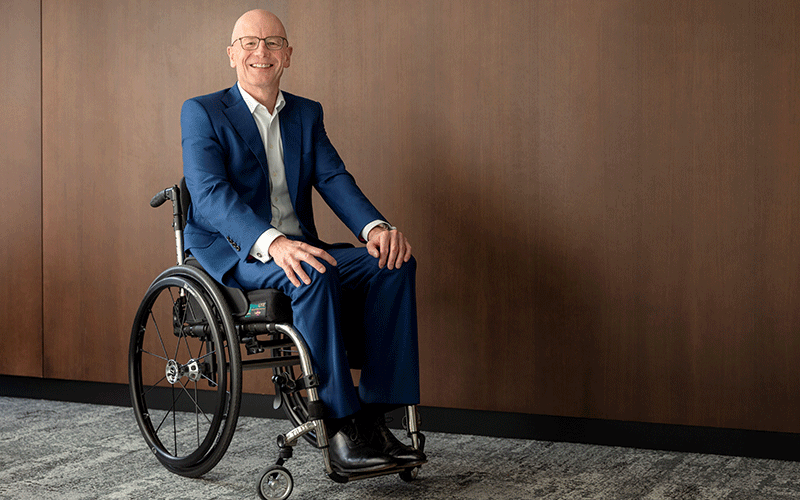
Steve Ingham
DeeDee Doke interviews the CEO at Michael Page

Most days, the sun seems to shine just that little bit brighter at Michael Page International. Poor economic conditions roll off the firm’s broad shouldered back more quickly than elsewhere in the recruitment universe. Buoyancy returns to its markets, and its coffers, a step or two quicker.
Two weeks ago, with the announcement of the global recruitment firm’s half-yearly results to June 30, Michael Page’s fortunes were yet again on the rise: revenues increased by 8% to £393.5m from the same period in 2009, and profits before tax had leapt by 42% to £61.4m from £43.2m over the same time frame.
The firm’s Q2 results, announced in July, had also brought similar good news, for the second quarter in a row. “We’re starting to feel like it’s part of a greater recovery,” Steve Ingham, CEO at Michael Page, told Recruiter soon after the Q2 results announcement. But Ingham is not declaring victory over the recession yet.
“All that said,” he continues, “it takes a brave man or woman to stand out there and say it’s all over, that we have no issues ahead of us. We have to be respectful of this recovery; I’m still cautious about how enduring the recovery will be - you can’t not be. It seems to be that every time we get a good bit of data, the following day there’s a bad bit of data, and suddenly you’re thinking, well, how quick is this recovery going to be?
“So we’re taking it quarter by quarter, but at the moment we’re feeling pretty good,” he says. “We have one country left to really click into growth mode - that was Holland - and even they were showing by the end of last quarter that they’re starting to recover.”
Ingham is in his fifth year as CEO of what is arguably ’top gun’ in recruitment worldwide. Michael Page is the company its competitors want to beat, and has the unstoppable, overarching presence in recruitment they want to have. Neither this positioning nor being under constant scrutiny from competitors is lost on Ingham, the ultimate company man who rose through the ranks from recruitment consultant to succeed Terry Benson in the big chair in March 2006.
“It’s quite phenomenal how much time other companies spend talking about us,” Ingham says. “We do the reverse. We spend no time talking about them. We’re focused on what makes us better and how we can grow and how we can improve. I mean, shareholders and analysts will say, ’oh, would you like to meet so and so’, and no, I have no interest. I’ve never met any of them, I have no interest in meeting any of them.
“To me,” he adds, “if you focus on getting our business right, our strategy right, retaining our best people, recruiting even better people, then we’ll stay ahead of the pack, no problem at all.”
Consistency in strategy was a hallmark of Michael Page’s business success before Ingham became CEO, and he says that consistency continues in his tenure. For instance, the firm derives its expansion purely through organic growth - offices in new countries, additional offices in existing territories, new sectors - instead of through acquisition. “Probably all I’ve done is refreshed what we were doing well before,” he says lightly.
The same organic growth philosophy applies to how the business is staffed. Expert outsiders are recruited into senior support roles, but never into senior operations roles. Michael Page, where the stated company vision is “maximising potential”, grows its own country managers, managing directors and CEO.
“I was promoted into the job rather than recruited into the job,” Ingham says of his own ascent, “and that makes a big difference. I’ve grown up with this strategy, this formula and culture, so it wasn’t that suddenly I was hired in externally to do the job. I think that would have been very challenging.
“It’s a people business - it’s much easier to have got the job through meritocracy and been promoted visibly within the organisation. People know me and why I’ve got the job.”
Asked to elaborate on how he “refreshed” the Michael Page business after succeeding Benson, Ingham says,: “When I took over we’d grown to a size where possibly the definition of the strategy and the definition of the culture had become hazy - we weren’t as meritocratic as I felt we could be. I don’t think we were as creative and as entrepreneurial as we could be. Neither were we as committed to growth as we could be. I think all I’ve done is sharpen that up.
“We use the term ’maximising potential’ a lot here, and there were many people that were under-utilised in the business five years ago. We were still very much about the Michael Page strategy, we were just doing it a bit slow, we weren’t maximising the potential of the strategy if you like,” he continues.
“Its edges were a little worn and we weren’t opening as many countries, we weren’t launching as many businesses, and there were people that were sitting around in jobs that had the ability to do that. So the first thing, five years ago, when we were in a growth mode and in a growth economy, we had to literally go through all of the people that we had around the world and better utilise them and faster.”
“That’s basically what I did: give people more opportunity, give them bigger jobs, more challenge and rewards that go with it,” he says. “A lot of time was spent around people and trying to better use them.”
Also, Ingham says, “we had become so big around the world, we were a little bit disjointed, so some of the bigger regions were operating a little bit like silos.”
Instead, he wanted Michael Page to exert a more global approach and deploy talent across geographic barriers as part of “one business, one world and move people further afield to make sure we maximise growth”.
And there were early dividends. “That’s probably why in 2007 we had our most successful year ever - not just in terms of profits, but our growth rate was at its highest. We grew our top line at 37% that year. I would love to have that every year,” he says.
Yet even the downward slide in world economic conditions may have given a further boost to Ingham’s efforts to sharpen Michael Page’s edge. “I think we’ve come out of the downturn almost refreshed in terms of our culture and our strategy going forward,” he reflects. “We’ve kept the entire business platform of countries, offices, senior management; we’ve kept all of our good people. I’m happy with that, and that’s probably why we have come out of this downturn faster than anyone else.”
A bank balance of £137.2m and continuing to operate in the black, turning profits even at the apex of the downturn in 2009 gave Michael Page the financial wherewithal to not only stand its ground, but to launch initiatives. “When others were closing countries and operations, we were doing the reverse - we said let’s launch [Michael Page subsidiary serving junior professionals] Page Personnel in Brazil, let’s launch in America, let’s do these things because they are the future growth opportunity,” he says.
At the same time, the firm’s head count fell by nearly 1,400, although Ingham says that most of the losses occurred through natural attrition. “In a downturn, when 70% of our costs are people, you are going to lose some employment costs,” he says. “Ultimately we were careful to do that through a meritocratic process.For instance, we lose our weakest and keep our strongest. That seems obvious, but most firms tend to mess that up and lose key people, rather than losing just people that can be replaced when the market is growing again.”
It is always about maximising the potential of a business, maximising everything we do - the thought of running a business just for glamour or for the pay cheque to me would be pointless
While he takes a cautious line about whether the recovery is yet in full swing, Ingham is bullish about near and long-term plans at Michael Page to keep the business growing, especially abroad. “If we go to a new country, we don’t go there because we’re going to have six people; we go there because we’re going to have 60 or 600 one day,” he says.
Clearly, the sun shines a little bit more brighly on Ingham himself, along with the company he runs. The day before this interview took place, his horse Regal Rave came first in a race at Bath, and an already framed photograph in his office revealed a beaming Ingham with the winner. And professionally, Ingham plans to stay out ahead and leading the field at Michael Page.
“This isn’t a great bus to jump on and get off at the next stop - it’s one that you jump on and go to the end of the line,” he says. “That’s how we all see it. I’ve explained this to my chairman once, he said, you have to look at ways of developing, and I said that’s fine. Of course, I will always look to ways to improve myself for the benefit of Michael Page. But not for my next job, because there isn’t going to be one. I don’t expect to be running Rentokil next or something else. I’m not building my CV for the next CEO job. This is it.”
I work harder than most people. I have always been committed.I compete every day. A lot of people think they work hard, but to get to the top of any business, you have to be incredibly committed every day, however you feel
Curriculum Vitae
2006-present CEO, Michael Page International
2001-06 Executive director, Michael Page
1994-2001 MD, Michael Page (also launched and managed retail and sales divisions)
1994 MD, Michael Page Marketing
Dec 1990-Sept 1994 Director, Michael Page Marketing
April 1988-Dec 1990 Manager, Michael Page Marketing
March 1987-April 1988 Consultant, Michael Page Marketing
1983-87 Various roles, Johnson Matthey
BSc (Hons) Metallurgy & Material Science, Nottingham University
Company Profile
Founded in 1976 by Bill McGregor and Michael Page to provide selection and recruitment services for accounting and finance professionals
Key facts
First office in Australia was opened in 1985
In 1995 Michael Page retires
In 2001 Michael Page International listed on the London Stock Exchange
2006, Steve Ingham is appointed CEO
In 2010 the company is operating more than 135 offices in 28 countries
:
Most popular
Most commented
-
New TV series seeking a recruiter with star power
-
AWR four months on: opinions still divided over position of limited company contractors
-
INTERNATIONAL Uruguay: Migration policy to flex to meet labour demand
-
Independent help with bright ideas
-
INTERNATIONAL Ireland: Sky jobs drive gives Irish economy welcome boost


Readers' comments (1)
Mark Samson | Fri, 3 Sep 2010 12:56 pm
Excellent profile
Unsuitable or offensive? Report this comment