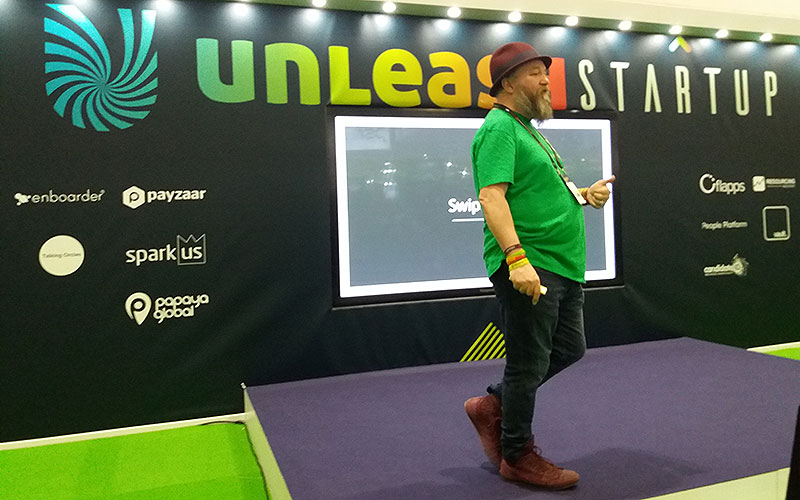
Bill Boorman
Colin Cottell uncovers the secrets of the social media guerrilla

Two years ago Bill Boorman was at a low ebb. “I watched the training business I had built up flow away pretty rapidly. I had nothing,” he says. Today Boorman is ranked the third most influential person in the field of online recruitment.
From contemplating a future of DIY and gardening, Boorman now lists Hard Rock Café, Sodexo and Accenture among his clients. It’s quite a transformation for someone who himself admits is “not remotely technical”. From 50 LinkedIn connections, mainly family and friends, Boorman has now posted more than 46,000 Tweets and built up a worldwide following.
Sitting in the lounge of the City Hotel on the fringes of London’s Square Mile in the City, wearing a black leather motorcycle-type jacket, trademark bowler hat and black t-shirt, Boorman is clearly revelling in this new yet seemingly unexpected phase in his life. “Everything has been an accident,” he says on more than one occasion, as if unable to believe his luck.
The City Hotel is not just any hotel, however, but the venue for the latest in a series of events Boorman has organised that have not only helped resurrect his career, but are also arguably shaping the future of recruitment.
Boorman’s philosophy
It’s about skills and what people can do, not what bits of paper they have. It is not about job titles. Go look for people, not for CVs
Boorman’s events are attended and followed through social media by some of the world’s leading thinkers and practitioners in social media in recruitment. Thought leaders, such as Kevin Wheeler, as well as corporate recruiters, such as Arie Ball, Sodexo’s vice-president of talent acquisition, are regular attendees at Boorman’s conferences. Actually, that should be unconference. September’s #TruLondon event was just the latest in a series of unconferences that Boorman has organised in places as far-flung as Romania, Sweden and the US.
First thought up in IT, an unconference is like no event most recruiters will have ever attended (see below). It was only two years ago that Boorman attended his first recruitment unconference in Dallas, where he gave a keynote address. At his second in Toronto, Boorman recalls, as the only person dressed in a suit and tie, because it was so hot he went and sat underneath a tree. “People came out all day and we just talked about recruiting and candidate experience, and all kinds of things,” he says. Boorman was hooked. “I just thought I loved this concept of the unconference no presentation, no PowerPoint and it was very participative,” he says.
From his first #Tru London event in November 2009, Boorman’s unconferences have clearly struck a chord. If all goes to plan, 15 unconferences will have been held during 2011, in three continents and next year Boorman plans 30.
Boorman seems an unlikely man to be at the forefront of social media in recruitment, a phenomenon that some believe could revolutionise the profession and the industry. “I am not a technical person in any way. I am not a digital media person. I always consider myself a recruiter and I have never really done anything else apart from work in the recruiting space,” he says.
And indeed it is more by luck, actually bad luck, than by design that he has ended up where he is today. Leaving school aged 16, Boorman worked for a number of City recruiters. Told he would never make it, and despite being sacked three times, Boorman persevered.
After 12 years at Primetime Recruitment as training director, Boorman set up his own training company. However, this was hit by the 2008 recession. “I had no purpose for getting up in the morning,” he says. Faced with a choice between “the washing up, cleaning, DIY or gardening, or to trying to do a bit of something”, Boorman chose “to do a bit of something”.
He admits that at the time he had no idea where he was going. But he took the plunge nevertheless. He first dabbled with social media, doing a bit of Tweeting and setting up ’The Good News Group for Recruiters’ on LinkedIn simply, he explains, “because everything was bad news at the time”.
Incongruously, Radio 1 DJ Chris Moyles sparked Boorman’s interest in Twitter as he listened in his car and soon he was captivated by the buzz around social media.
“All Twitter is is a giant version of everyone poking their noses over the wall and having a little look into other people’s lives. I think recruiting is like that, in that you are asking questions and gaining information all the time about lots of different worlds. And when you put that into Twitter or Facebook you can be pretty informed about most things,” he adds, explaining why social media and recruiters make good bedfellows. Boorman’s Tweeting and re-Tweeting soon began to take off he has now posted more than 46,000 Tweets and counting.
This led to an appearance as a guest on Recruiting Animal, a US online ’shock jock’ type radio show. After one show featured mobile applications, Boorman began to realise that in some ways the UK was ahead of the US in how it used technology in recruitment. “We had been doing text messaging for 15 years as standard,” he says.
“I began to realise there were really early adopters in the industry, who had an interest in pioneering things. We were all trying to work out how to we use these channels for recruitment,” he says.
Not surprisingly, Boorman believes that the rise of social media within recruitment is more than just self-generated and self-perpetuating hype from the social media ’in crowd’. He points to his own success in using Facebook to find 120 staff for The Hard Rock CafŽ in Florence. And he positively drools over the success of Ivan Stojanovic, a recruiter at Irish staffing firm CPL, who used Twitter to source 27 specialist IT staff, even though they didn’t have CVs and weren’t looking for work.
However, Boorman is also appreciative of the business opportunities that #Tru and the social media buzz that has built up around him has provided. He describes how Keith Potts, the founder of Jobsite, contacted him on Twitter to ask if he would like a sponsor for #TruLondon. “How many calls would I have to make to get that?” he asks.
Boorman is also aware how his blogging and his Tweeting have enhanced his own personal brand, catapulting him to number three in the trakkr/HRExaminer index of “most influential online recruiters”.
His influence is not lost on Craig Fisher, founder of social media consultancy Fishdogs. It was Fisher who invited Boorman to his first unconference in Dallas. “He [Boorman] stormed onto the Twitter scene with a plan to Tweet more than anyone in the space. He did just that, gaining notoriety and considerable influence among recruiters worldwide. He is a great connector and uses technology and networking to that end like few people I know. He thinks, he studies and he innovates. Our community is much richer for his involvement.”
Rob van Elburg, owner of IT recruiter RAVE-cruitment, says Boorman’s contribution has been unique. “Gathering the best recruiters in the world, in cities like Amsterdam, Boston, Bucharest, London, Stockholm, Melbourne, Kaapstad… Only one person can do that. Bill Boorman. He is the right man, in the right time, in the right job to make this all happen. Inspirational, entrepreneurial, disorganised, unconferencial and most of all great fun.”
However, Boorman himself appears keen to play down his own importance. “#Tru is more important than Bill Boorman. It’s more important to push the conferences so they continue to run themselves,” he says. That said, when asked to define himself, his answer is perhaps illuminating: “My job title is being Bill Boorman, really,” he says.
Boorman has undoubtedly become a popular character on the social media recruitment scene. After someone spilt coffee on a t-shirt last year, around 70 people tweeted pictures of it. Boorman now changes his t-shirt seven or eight times a day.
Always with one eye on humour, one of his favourite t-shirts is emblazoned with ’I poached your HR manager’. And wherever he goes, Boorman has become known as “the guy in the hat”. He now sports a growing collection, from ten-gallon hats worn in Dallas to his trademark bowler hat. “It just makes you a little bit quirky and unique in an over-populated space. Business needs characters. If we all agreed, some of us would be irrelevant,” he adds, stealing what he says is a well-known business quotation, but whose antecedents escape him.
In addition to organising unconferences, Boorman has a number of other strings to his bow: building clients’ internal brands and speaking at various events among them. He appears genuinely surprised that since immersing himself in all things social media, events have turned out so well. “If I had planned any of this I could call myself a genius,” he says.
Be that as it may, after hitting rock bottom in his career just two years ago, Boorman is loving every moment of his new lease of life. “I used to work for a living, now I travel the world talking about recruitment; there is not a lot bad about that,” he says.
Secret of my success
I don’t fear failure, I don’t worry about things not working, but focus on how can I make it work. I expect to get a lot of things wrong, but when I do I learn from it and I move on
Curriculum Vitae
2009 @Bill Boorman Incorporating #Tru The Recruiting Unconference, founder
2006-10 Bill Boorman Consultancy, founder
1994-2006 Primetime Recruitment, training director
1993-94 Perriam & Everett, recruitment consultant
1981-93 New Street, Guardian, Crystal Recruitment, recruitment consultant
Non-executive director to five staffing companies
What happens at an unconference?
- At an unconference, the emphasis is on informality and participation.
- An unconference involves a number of tracks or topics. Each track is led by a track leader, who encourages as many people as possible to join in the discussion. People wander from track to track.
- There is usually no lunch provided and the surroundings can be as insalubrious, making it much cheaper than a traditional conference.
- Unconferences organised by Boorman are much more than what goes on inside the room. Much of ’the buzz’ comes from people who post blogs and communicate through social media both before and after the event.
Most popular
Most commented
Most emailed
-
Local government: competition “pretty healthy”
-
Countdown to automatic pension enrolment: what do staffing and umbrella companies need to do?
-
The Reed case: are concerns over travel schemes justified?
-
Virgin wants 500 new cabin crew to ‘live the spirit’
-
Permanent and temporary placements in Scotland rise again


Readers' comments (8)
Sean O'Donoghue | Wed, 5 Oct 2011 11:05 am
Everything here looks very good to a typical HR or internal recruiter. However, what I'd like to know from Bill is this:
What are you doing to help support actual recruitment agencies these days??
Without meaning to sound too harsh, it seems like Bill came up against the recession in 2008, just like the rest of us... but rather than looking for a way to help coach agencies to weather the storm, he jumped ship and decided to help show companies how to recruit directly using social media.
I can't help but feel as though Bill has been a traitor to recruitment agencies lately, but then I don't personally know Bill and can only comment on what I'm seeing and hearing him talk about online.
Perhaps we need to have a chat Bill... I could be totally wrong about all of this, and I really hope I am - in which case I'd apologise whole heartedly for taking your actions the in the wrong way! I'd love to work with you if you could just show me what you can do to support small boutique agencies going forward...
Given your new position, you'd make an ideal Ambasador to help bridge the barriers between recruitment agencies and HR/internal recruiters. You could (and should) be showing them how best to partner with us... although if you're doing the opposite, you're in effect taking the bread away from our tables, and making our jobs all that much harder.
I get that companies want to see cost effective recruitment strategies, and showing them what you did with Hard Rock Cafe is going to be an easy sell... it's hard for any agency to compete with that. However, social media recruiting is definitely not in the best interests of all companies. Agencies still have a huge amount to offer, especially when they work with the levels of professionalism, drive, and commitment that we see in all of the boutique IRG member firms.
Are you choosing sides now Bill, or are you still willing to actively promote the services of specialist recruitment agencies to the companies you deal with?
Sean O'Donoghue
Founder
The Independent Recruiting Group
www.irg-uk.com
Unsuitable or offensive? Report this comment
Recruiting Animal | Wed, 5 Oct 2011 12:22 pm
Oh, Billy, betraying the Commonwealth? You know the Recruiting Animal is Canadian. U met me in Toronto under that tree.
Unsuitable or offensive? Report this comment
Recruiting Animal | Wed, 5 Oct 2011 12:55 pm
If I'm not mistaken @BillBoorman was first interviewed by the great @BillVick. I'm pretty sure that's how I found out about him
Unsuitable or offensive? Report this comment
Ivan | Wed, 5 Oct 2011 1:11 pm
Hi Colin,
I have read a lot of interviews with Bill and reviews of his work. No one has put Bill into words better than you. Well done!
Ivan
@IrishRecruiter
Unsuitable or offensive? Report this comment
@BillBoorman | Thu, 6 Oct 2011 0:11 am
Sean,
I'm a bit surprised by your comments. When you ran the IRG Summit a few months ago, you might recall that I ran a session for you at no cost.
Here is the reality of the situation. When I run a #tru event, the doors are open to anyone. The majority of attendees come from the corporate sector. I work with the companies who contract me, and most of the calls come from direct businesses. I'm always more than happy to work with agencies. I'm not one of the agencies are dead crowd.There is some great work going on out there.
You, yourself, chose to leave a corporate business in Jonathan Wren who had trained and supported you. You chose to set up on your own. You left an REC environment and set up a rival industry body, which you now promote. Were you a traitor or did you move to where there was demand and your services were needed? I tip my hat to anyone running a business in any sector they choose.
I'm hoping I don't deserve to be sent to the tower just yet! Feel free to call me any time you want a conversation.
@Animal,
I know you are a Canadian, we did meet under the tree and it was the great Bill Vick who first interviewed me.
@Ivan,
I concur!
Bill
Unsuitable or offensive? Report this comment
Darren Ledger | Fri, 7 Oct 2011 4:31 pm
I never realised that Primetime had such an outstanding reputation for quality, innovation and integrity in terms of recruitment that the former Training Director would become a recruitment 'Guru'!
I have to admit the article has little in the way of content, to be honest I suspected it was another pointless plug for the IOR! Well almost right, it's another pointless plug!
Unsuitable or offensive? Report this comment
Sean O'Donoghue | Sat, 8 Oct 2011 7:51 am
Bill,
We've cleared this up between you and I personally, so I apologise for my misconceptions of you. I mean that sincerely.
However, you made some big misconceptions yourself in your points above:
1. It was the ARG summit you spoke on, run by a US organisation, and my old boss, Neil Lebovits. I'm surprised you offered your material for free - when there was such an extortionate fee for recruiters to gain access to the recorded material after the event. Still, it wasn't our event, and had it been, we would have charge no fees whatsoever to recruiters to watch it, as it's not in our interest to profit from supporting our community.
2. The IRG is not a professional body. We do not compete with the REC or IOR. We are a community-led social enterprise - our members lead our organisation, and thus we are run by recruiters, for recruiters. We do not charge fees, and support our members purely because we care about supporting the small agencies first and foremost, without any financial motivation whatsoever.
3. Jonathan didn't train me whatsoever, or support me - hence why I left in order to operate outside of a KPI-driven environment where profits come before service.
Anyway, you'll see now how easy it is to get the wrong idea about a person or an organisation without fully doing your research first. Lesson learnt on both sides I think - and I'll be interested to attend your next Tru Manchester event - and continue our conversations offline.
Best of luck.
PS. Darren, you're not wrong - which is why I made my initial assumptions above. I guess the article was never intended to spark debate, merely highlight Bill's resurrection over the last two years.
Unsuitable or offensive? Report this comment
@P3t3rT1 | Fri, 14 Oct 2011 8:54 am
This is a great article about someone with passion, drive and enthusiasm and Bill's biography offers a lot of learning points for all of us about how we can each be successful.
To Sean O'Donoghue: I do not understand why you picked this as a platform to have a pop at Bill? In a fairly short period of time, Bill has helped many recruiters and recruitment agencies (among others) understand how the industry is changing and what we need to do to ensure our own survival. Bill has become a major influence in this area online and via the #Tru events. I have no desire to defend Bill (he can do that well enough on his own) or to start a great debate but I hope you can learn from what Bill has achieved and apply it to your own organisation.
I've been working in the recruitment industry for over 10 years and been active via social media for a few years and I have never heard of you or the IRG before I read your negative comments above - that's a pretty damning statement and does not put the IRG in a positive light from the outset.
If you want your organisation to succeed and you want help, you have to find another way to get noticed. In a positive way. Engage with the various communities online, attend events, network, hold your own events to beat your drum and get your voice heard.
Unsuitable or offensive? Report this comment